

Something on your site is quietly broken.
It usually is. Send us your URL and we'll run a FREE 27-point check - security, speed, accessibility, SEO - and tell you what's wrong, what can wait, and what's fine.
No pitch. No obligation.

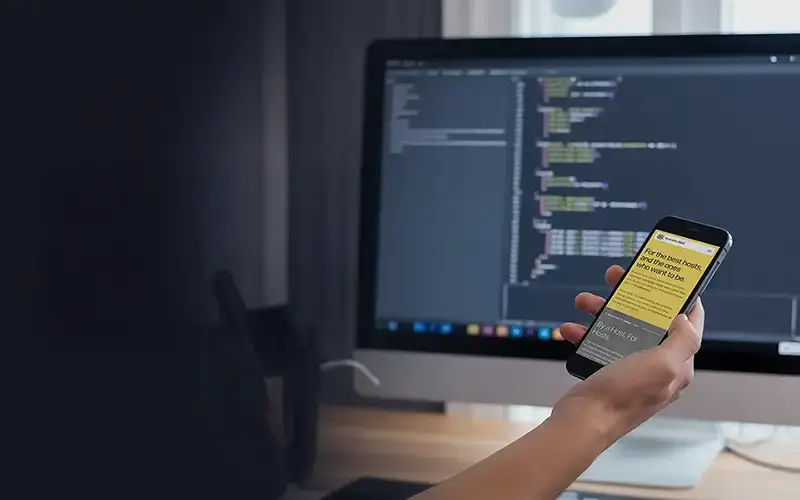
Building a website used to be the expensive step. It is not anymore. You can describe what you want to a tool like Base44, Lovable or Bolt and have something live in an afternoon, and honestly, that is a good thing.
But knowing what to build, whether it actually works, and keeping it alive after launch has not gotten any easier. Those were always the hard parts. They just used to be hidden behind the difficulty of building at all.
This page is where we lay out how we think about it, what we use AI for, and where we think you still need a person.
Getting something on screen.
A working prototype in an afternoon instead of two weeks.
Exploring options.
Three real directions to react to, not three static mockups.
Boilerplate.
The repetitive markup, the standard components, the first draft of anything.
Cost of being wrong early.
Test an idea cheaply before committing a budget to it.
Deciding what the site is for.
One primary action, everything else in service of it. Most sites fail here first.
Knowing what to ask for.
Turning "I need a website" into specific decisions about order, emphasis and what to cut. This was always the actual job.
Knowing what you did not think to ask.
AI answers the question it was given. It cannot ask on your behalf, because it does not know which of a thousand possible questions matter to your business.
Everything after launch.
Hosting, security, accessibility, updates, and being reachable when something breaks.
We are not precious about this. AI is in our workflow every day and it makes us faster. What it does not do is choose the typeface, decide the page structure, or determine what your business should be leading with. Those are decisions, and decisions need a reason behind them.
The same hero, the same three-card grid, the same font, the same purple. It is not a coincidence and it is not laziness. It is what a prediction engine returns when you ask it for a website. The trouble is that your customers recognize it too, and what it signals is that nobody was really here.
We wrote about the mechanism behind this in why every AI-built website looks the same.
Every defense of an AI-built site runs through the same move: sure, but you can direct it. True, and it takes correction better than most people expect. But direction has to come from somebody, and that somebody is usually a person who has never designed a website and has no particular reason to know what separates a page that converts from a page that just sits there. That is not a criticism. It is a specialty, the same way plumbing is.
The deeper half is what happens after. Designers have an eye, which is not taste in the sense of having opinions about colors. It is trained discrimination - the ability to look at something and know it is wrong slightly before you can explain why. Spacing that says nothing belongs to anything. Two typefaces quietly fighting. Four bold things, so nothing is bold. Text that clears a contrast checker and is still miserable to read.
You can see every one of those once it is pointed out. That is the problem. Recognition is easy and detection is hard, and detection is the whole job. AI has no discrimination function at all: ask it whether a design is good and you get fluency, not judgment, and it will defend the opposite design just as convincingly.
More on that in AI can copy good design, it cannot recognize it.
An AI-built site is a very good starting point. It is not a finished business tool. What sits between the two is testing, accessibility, security, proper hosting, and someone who is still around in six months. That gap is the entire job now.
Two situations come up over and over. Chances are you are in one of them.
It looks alright. It mostly works. But you're either stuck finishing it up and launching, unclear implementing certain aspects or just don't have the darn time to get it done.
You want a real site up fast and you do not need a full custom build or unique design. The same speed advantage of doing it with AI, except a professional is steering it, testing it, and setting it up on hosting.
Not at all. We use it. They are excellent for prototyping, for testing an idea, and for getting a first version on screen quickly or for coding the real thing.
What we push back on is treating the output as finished. A generated site is a starting point that looks like a destination, and that is an easy thing to get wrong.
Usually, yes, and it is normally cheaper than starting over. We look at what you have, tell you honestly whether it is worth keeping, and give you a fixed scope either way.
If it is not worth keeping we will say so rather than quietly rebuilding it and billing you for the discovery.
Because a language model produces the statistical average of everything it has seen, and what it saw most between 2019 and 2024 was Tailwind CSS component examples with indigo accents.
It never decided purple was good. It learned that purple is what buttons are. The same applies to the font, the three-card grid and the gradient hero.
It can be, and the risks are quiet ones. In 2025, researchers at Escape scanned over 5,600 public apps built on vibe-coding platforms and found more than 2,000 vulnerabilities, over 400 exposed secrets and 175 instances of exposed personal data. That is the one figure here measured specifically on AI-built apps, and it is the reason we start with security.
If you use sites like Base44, Lovable or Bolt then the sites sit on their servers. If they shut down or disappear, so does your site.
Accessibility is the other common gap, though the numbers there are broader. Across the whole web, 95.9 percent of top home pages had detectable accessibility failures in 2026, and the most common ones - low contrast, missing form labels, missing alt text - are exactly the defaults a generated site inherits without anyone noticing. In California that can become a legal question as well as an ethical one. The law is more complicated than a FAQ answer allows, we build websites rather than practice law, and we went through it properly in website accessibility lawsuits in California.
None of this shows up as an error on your screen. That is the whole reason it is worth having someone look.
Fast where speed helps and deliberate where it matters. We use AI to move quickly through the parts that really are repetitive, then apply actual design judgment, test on real devices with real people, handle accessibility and hosting properly, and stay reachable afterward.
You can see the full range on our services page.
Send us the site. We will tell you honestly what is working, what is not, and whether it needs a fix or a rebuild.
