



Should I Hire a Designer or Use a Pre-Made Shopify Theme?
It is usually a budget question - but the DIY theme route hides a cost most people do not see coming. Here is the honest answer, when a theme really is the right call, and the semi-custom middle path most stores actually need.
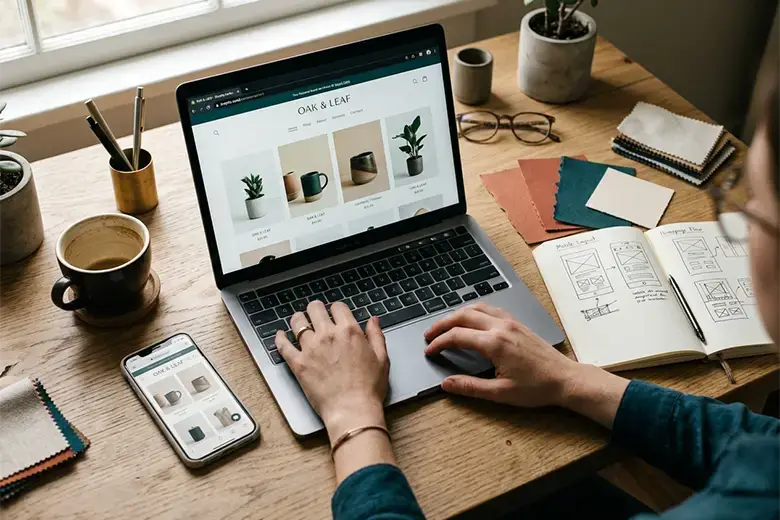
Almost every time someone asks us this question, the real question underneath it is about money. They do not have the budget for a designer, a pre-made theme is a fraction of the cost, and the assumption is simple: how hard can it be to set one up myself? It is a fair place to start. Themes are cheap, they look great in the demo, and Shopify has made the setup genuinely approachable. But that assumption - that DIY is the easy, obvious way to save money - is the single most expensive one we see store owners make. Not because themes are bad, but because the theme was never the hard part.
So let us answer the question properly, without the usual designer-selling-design bias. There are stores that should absolutely buy a theme and get on with it. There are stores that will quietly leave money on the table for years if they do. The trick is knowing which one you are.
The DIY assumption, and what it actually costs
The reason DIY looks cheap is that the price tag you compare is the theme against a designer's invoice. But that is not the real comparison. A theme does not make design decisions for you - it just gives you a set of good-looking defaults and a lot of empty slots to fill. Filling those slots well is the job, and it is a job most people have never done.
Here is where it goes wrong, over and over. The first gap is taste. Knowing what looks good is a skill, not a preference, and if you do not have it, no theme will hand it to you - you will pick the wrong fonts, crowd the layout, and end up with something that feels a little off in a way you cannot name. The second gap is flow. Designing the path a visitor takes from landing on your store to clicking buy is a craft, and getting it wrong is invisible to you and costly on every visit. The third gap is judgment about information: knowing what deserves to be on the page and what is just clutter, what a customer needs to see to feel confident buying, and what quietly kills the sale. A theme cannot make those calls. It assumes you already can.
None of this shows up on day one. On day one your new store looks fine. It shows up three months later in a conversion rate that never climbs, a bounce rate you cannot explain, and the slow suspicion that the store is not pulling its weight. That is the real cost of DIY, and it does not appear on any invoice.
But themes have proven layouts - is the flow not already built in?
This is the fair pushback, and it is worth answering head-on. Modern themes from the Shopify Theme Store are genuinely good. They are professionally designed, mobile-friendly, fast, and built by people who understand e-commerce. The layouts are proven. So yes, a theme gives you a solid, sensible starting point - far better than a blank page.
The catch is that a theme is designed for the average store, and your store is not average. The demo was styled with perfect photography, a handful of products, and content written to make the theme look its best. Your catalog, your imagery, your brand voice, and your customers' actual questions are different. A proven layout populated with the wrong content, in the wrong order, is no longer a proven layout. The structure is a head start, not the finished race.
When a pre-made theme really is the right call
Now the honest other side, because we do not believe every store needs a designer. Sometimes a theme is exactly right, and we will tell people so.
The clearest case is cost and time. If a full custom design-and-build is out of reach, a good theme lets you launch a professional store quickly and affordably, and that is a real, legitimate win - a live store making sales beats a perfect store that never ships. The themes out there are strong, and for a simple catalog with a clear offer, a well-configured theme and some thoughtful content can carry you a long way.
The place to be honest with yourself is what a theme cannot do. In our experience, pre-made themes rarely include every feature you need to really deliver - the specific layout, the particular product experience, the functional detail that sets your store apart. And the pattern we see most often is this: a store owner picks a theme, builds happily on it for a while, and then hits a wall the moment they want to add something the theme simply does not allow. Now they are stuck - locked into a foundation that will not bend, facing a rebuild they did not budget for. The theme was not the problem on day one. It became the problem the day their ambition outgrew it.
So a theme is the right call when your needs are straightforward, your budget is tight, and you are honest that you may hit that wall later. It is the wrong call when you already know you will need more than the template offers.
The answer most stores actually need: semi-custom
Here is the part the hire-or-DIY framing misses entirely. It is not a binary. The approach we use with most of our clients - and the most popular one by far - is what we call semi-custom. You start from a well-built pre-made theme, then customize the code and the design so it matches your brand and does what your store actually needs it to do.
This is the sweet spot, and it exists precisely because it solves the two failures above at once. You are not paying for a fully custom build from scratch, so the cost and timeline stay reasonable. But you are not stuck with the theme's defaults and its ceiling either, because a developer and designer are shaping it around your brand and your functional requirements. You get taste, flow, and the right information architecture applied by people who do this for a living - on top of the speed and affordability of a solid theme foundation. When you hit the wall the DIY-only owner hits, you have already built the door through it.
Semi-custom is why the question "designer or theme?" is a little bit of a false choice. The best answer, for a growing brand, is usually both: a theme as the foundation, a designer to make it genuinely yours. We make the fuller case for this approach in why pre-made and semi-custom Shopify themes are the best choice for your e-commerce store, and we compare all three routes - theme, semi-custom, and fully custom - honestly in Shopify themes or building a custom theme?
A middle option before you commit to either
If the thing pushing you toward a designer is one specific layout your theme cannot do - a comparison table, a shoppable lookbook, a better gallery, an ingredients breakdown - you may not need a full engagement at all. This is exactly why we built AbraSections, a library of pre-built, customizable Shopify sections you can add to your store and configure yourself, no code and no developer required. It lets a DIY store owner reach past the theme's ceiling for a specific need without committing to a rebuild. It will not give you taste or fix a broken flow - only a designer does that - but for a well-defined feature gap, it is often all you need.
The one question to ask yourself
If you have to make the call today, forget the price tags for a second and ask yourself this, honestly: do you really believe you can handle everything that needs to be done here - the look, the flow, the decisions about what matters - and get the maximum potential out of what your website is capable of? If the answer is a confident yes, buy a good theme and go build. Plenty of owners do it well.
But if there is hesitation in that answer - if you are not sure you know what good looks like, or you suspect your store could be doing more than you know how to make it do - that hesitation is worth listening to. That is the moment to bring in a professional who does this every day, before you spend months finding out the hard way. The cost of hiring a designer is visible and finite. The cost of a store that quietly underperforms is neither.
Where Abra fits
We are Shopify experts based in Los Angeles, and we work across the whole range - well-configured theme setups, semi-custom builds, and fully bespoke development. Most of our clients land on semi-custom, because for a growing brand it is the honest best value: distinctive where it counts, efficient everywhere else. If you already have the design handled and just need it built properly, we also offer Shopify development services for designers.
Whichever way you are leaning, the point is not to hire a designer for the sake of it, or to save money in a way that costs you later. It is to end up with a store that looks the way your brand deserves and sells better than the alternative. If you want a second opinion on which path fits your store, tell us what you are picturing and we will give you a straight answer. And if you are just getting started and want to experiment first, you can spin up a free Shopify trial and see how far a theme gets you.
Disclosure: some links in this article are affiliate links. If you start a Shopify plan through them, we may earn a commission at no extra cost to you. AbraSections is our own product. We only recommend tools we actually use with our own clients.
Wondering what shape your own site is in?
Get a free 27-point Website Health Check - security, speed, accessibility and SEO. Plain English, no pitch.
Check my site